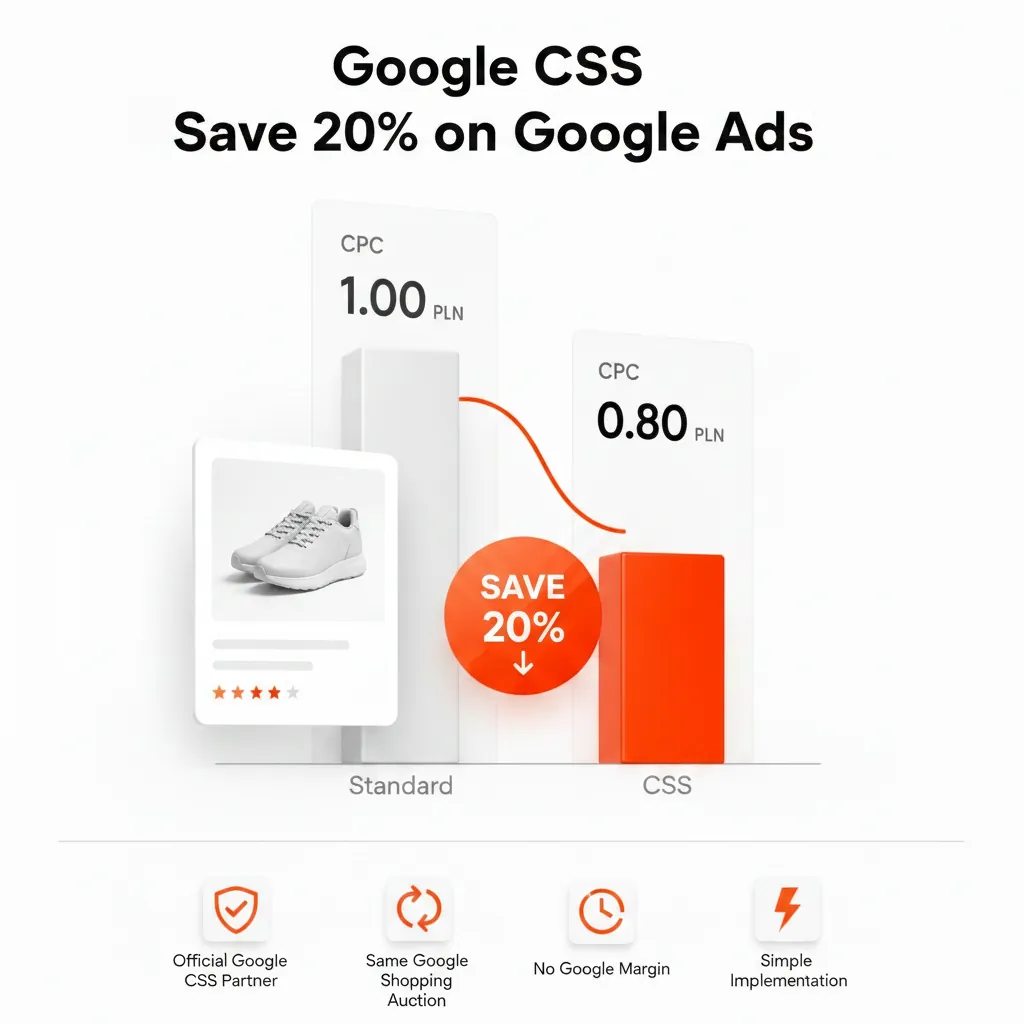
A CSS partner agency is usually a PPC or e-commerce agency that runs a client's Google Shopping campaigns and places them through a comparison shopping service (CSS): one it owns, one it offers under its own brand (white label), or a CSS partner it refers the client to. The CSS places the ad in the auction; the agency manages the feed, campaigns and reporting. In the 21 countries of Google's CSS program, that combination can lower Shopping CPCs by up to 20% compared with Google Shopping, depending on category and competition.
This guide explains who does what between merchant, agency and CSS, the four ways agencies work with Google CSS, and what to ask an agency that offers CSS – based on Google's own help pages. New to the topic? Start with what Google CSS is.
CSS, agency, Google Partner: three different roles
What the CSS does
A CSS is a comparison shopping service that takes part in Google's CSS program. It places product offers in the Shopping auction on behalf of merchants, and its name appears in the ad as the "By [CSS name]" link. Google requires a separate Merchant Center account for each merchant a CSS represents, and a Merchant Center account can be associated with only one CSS at a time. Google Shopping is also a CSS; an independent one is often called a Google CSS partner.
What the agency does
The agency works on the advertising side: product feed, campaign structure, bidding, budgets and reporting. An agency does not need to be a CSS to do this. What changes with a CSS is only which comparison shopping service places the client's Shopping ads – not who manages the campaigns.
Google Partner badge vs CSS Partner tiers
These are two different programs. The Google Partners program is for agencies that manage Google Ads accounts; its badge depends on criteria such as optimization score, ad spend and certified staff. The CSS Partners program is for comparison shopping services, with its own tiers, including Premium CSS Partner. An agency with a Google Partner badge is not automatically a CSS, and a CSS with a CSS tier is not automatically a Google Partner agency. The CSS tiers are explained in what Google's CSS Premium Partner badge means.
Three ways a CSS works with a merchant
Google describes three common working models between a CSS and a merchant. Agencies fit into all three:
| Model | Who runs feed and campaigns | Merchant access |
|---|---|---|
| Managed | The CSS (or the agency working with it) runs feeds and campaigns for the merchant | The merchant usually has no access to the Merchant Center and Google Ads accounts |
| Self-service | The merchant – or its agency – manages feeds and campaigns itself | Full access to its own accounts |
| Hybrid | Tasks are split, e.g. the CSS handles the feed and the merchant or agency runs the campaigns | Depends on the split; a new Merchant Center can be linked to the existing Google Ads account |
For most agency clients the self-service or hybrid model is the natural fit: the agency keeps managing the client's Google Ads account, and the CSS is linked through Merchant Center.
Where the agency fits: four setups
1. The agency manages campaigns, the client picks its own CSS
The simplest case. The client chooses a CSS partner directly, and the agency keeps running the Shopping or Performance Max campaigns as before. The agency adds no CSS service of its own – it only needs to know that the CSS is linked at Merchant Center level. Our guide to choosing a Google CSS partner covers fees and checklist.
2. The agency refers clients to a CSS
The agency recommends a CSS partner and may receive a referral commission. Client ads show the CSS partner's name, and the CSS partner invoices the client. How referral income compares with running CSS under your own brand is covered in CSS affiliate vs white label.
3. The agency offers CSS under its own brand (white label)
The agency offers CSS to clients as its own service: client Shopping ads show the agency's brand, and the agency sets its own client pricing, while a CSS provider runs the comparison site and the Google program side. This is the setup most agencies mean when they talk about "CSS for agencies". How it works in detail: white label CSS for agencies; what it costs with Feedve: the white label CSS partner plan.
4. The agency becomes a CSS itself
An agency can also register its own CSS. Google's requirements include running a comparison shopping website, representing at least 50 distinct merchant domains per country and keeping a separate Merchant Center account for each merchant. That is a real product and compliance commitment, not a setting in Google Ads. Details: Google CSS partner requirements.
What changes for the client when an agency brings in a CSS
- Google Ads stays. The client keeps its Google Ads account, campaigns and history. The CSS is associated with the Merchant Center account, not with the campaigns.
- One CSS per Merchant Center account. Working with several CSSs at the same time is possible, but each needs a separate Merchant Center account. Google says a merchant is never second-priced against itself in the auction.
- Free listings. In Europe, only one CSS can be used for free listings.
- The switch is approved by the merchant. The new CSS sends the request from its CSS Center, an admin of the client's Merchant Center account approves it, and it takes effect after a grace period of up to 14 days.
- Billing. The client pays the CSS for its service, not Google; Google lets each CSS choose how to invoice its merchants. In a white label setup, the client sees the agency's invoice.
Step by step: how to switch CSS partner in Google Merchant Center.
Questions to ask an agency that offers CSS
- Whose CSS is it? The agency's own, a white label CSS, or a partner it refers you to?
- Whose name appears in my Shopping ads? The "By" link shows the CSS brand.
- Who owns the Merchant Center and Google Ads accounts? Make sure you keep ownership and admin access.
- Is the CSS fee shown separately from the management fee? You should be able to see what the CSS itself costs.
- Which of the 21 CSS countries are covered? See the list of CSS countries.
- What happens to the CSS if I leave the agency? Agree in advance whether you stay with the CSS or switch, and who starts the switch.
Feedve for agencies and merchants
Feedve is an independent CSS partner in Google's CSS program, available in all 21 CSS countries. Feedve is not a Google Premium CSS Partner and does not claim Google certification. Agencies can offer Feedve under their own brand with the white label CSS for agencies plan; merchants and in-house teams can join directly with a flat monthly or annual fee – see pricing. To see what a lower CPC could mean for a client account, use the CSS savings calculator.
FAQ
What is a CSS partner agency?
Usually a PPC or e-commerce agency that manages a client's Google Shopping campaigns and places them through a comparison shopping service – its own, a white label CSS or a partner it refers the client to. The CSS places the ads; the agency manages them.
Can an agency become a Google CSS partner?
Yes, but becoming a CSS means meeting Google's CSS program requirements, including a comparison shopping website and at least 50 merchant domains per country. Most agencies instead offer CSS through a white label provider.
Is a Google Premium Partner agency the same as a CSS Premium Partner?
No. Google Partner and Premier Partner badges belong to the Google Partners program for agencies managing Google Ads. Premium CSS Partner is a tier of the separate CSS Partners program for comparison shopping services.
Do I need an agency to use a CSS?
No. A merchant can join a CSS partner directly and keep managing its own campaigns. An agency is useful if you want someone to run the feed and campaigns; the CSS choice is separate.
Does my agency need access to Merchant Center to switch CSS?
The switch must be approved by an admin of the merchant's Merchant Center account. If the agency is an admin, it can approve; otherwise the merchant approves the request itself.
How do agencies offer CSS to clients?
Through a referral program, under their own brand with a white label CSS, or by becoming a CSS themselves. For the white label route, see white label CSS for agencies.
Sources
- Google Merchant Center Help – Working with Comparison Shopping Services
- Google Merchant Center Help – About advertising with Comparison Shopping Services
- Google CSS Center Help – CSS program requirements
- Google CSS Center Help – Switch merchant accounts between Comparison Shopping Services
- Google Ads Help – About Google Partners