A CSS Premium Partner is a comparison shopping service (CSS) in the highest tier of Google's CSS Partners Program. According to Google, a CSS reaches this tier when it ranks in the top 10% of all CSSs by volume of Shopping ad impressions in its region and commits to an annual Joint Partnership Plan with four Quarterly Business Reviews with Google. The badge tells you that a CSS is large and works closely with Google. It does not tell you what you will pay per click or how much you will save.
This article explains the three tiers of the program, how a CSS earns Premium status, and what the badge should and shouldn't change when you choose a Google CSS partner. All program details come from Google's own pages, linked at the end. If you are new to the topic, start with what Google CSS is.
What the CSS Partners Program is
In the 21 countries of Google's CSS program, Shopping ads have to be placed by a comparison shopping service. Any CSS that has been onboarded can place ads. On top of that, Google runs a separate partners program for CSSs. Google describes its benefit like this: becoming a Google CSS partner gives a CSS access to expert training, strategic insight and technical support.
The partners program is about the relationship between a CSS and Google. It is not a separate auction, and it doesn't give any CSS reserved ad space. According to Google, all CSSs compete in the same Shopping auction and have access to the same features, including conversion reporting and automated bidding.
Participant, Partner, Premium Partner
| Tier | Google's description | Requirements (cumulative) |
|---|---|---|
| Participant | For any CSS looking to scale | Being part of the CSS program |
| Partner | For an established CSS managing at least 50 merchants | At least 50 merchants with active Shopping ads campaigns (at least one impression in the last 30 days); top 20% of all CSSs by volume of Shopping ad impressions in the region |
| Premium Partner | Specialist support, suitable for a top-performing CSS | Top 10% of all CSSs by volume of Shopping ad impressions in the region; an annual Joint Partnership Plan (JPP); four Quarterly Business Reviews (QBRs) with Google |
How a CSS earns Premium status
Top 10% by Shopping ad impressions
The main threshold is volume. A Premium Partner has to be among the top 10% of CSSs in its region by the number of Shopping ad impressions it serves. That is a measure of scale: how many ads the CSS places for all of its merchants together.
Joint Partnership Plan and Quarterly Business Reviews
A Premium Partner also commits to an annual Joint Partnership Plan with Google and takes part in four Quarterly Business Reviews a year. In other words, it has a planned, regular working relationship with Google's CSS team.
Rolling 30-day metrics and an annual review
Google says most metrics are based on a rolling 30-day window that the CSS has to sustain, so a single good day is not enough. Requirements are checked in a formal review once a year, and tier changes happen only after that review.
Premium Partner vs the Google Retail Expert badge
These are two different things. The Google Retail Expert badge is linked to training: according to Google, a CSS earns it once two or more team members are certified at CSS Academy NEXT. Premium Partner is a program tier based on impression volume and the partnership commitments described above. A CSS can mention one without having the other, so check which one a provider actually refers to.
What Premium status tells a merchant – and what it doesn't
It measures the CSS's scale, not your results
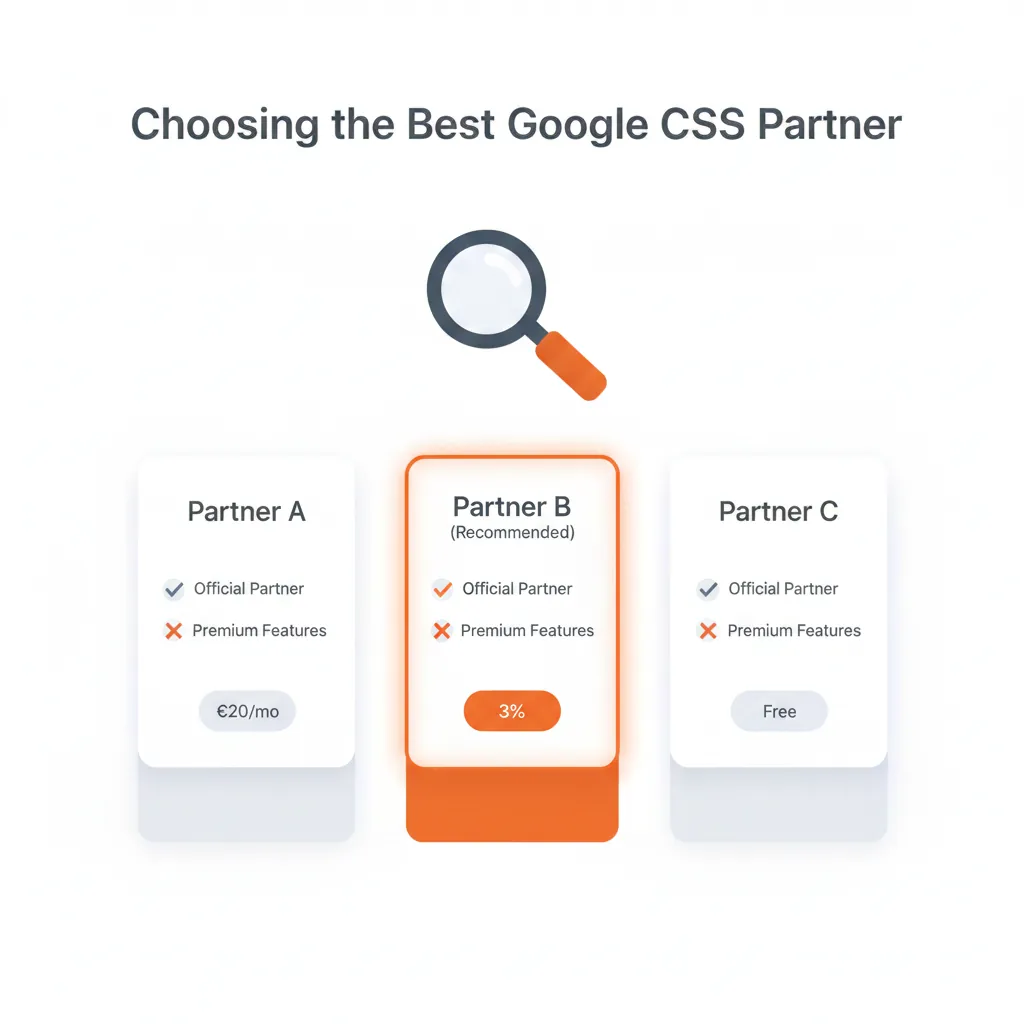
Every Premium criterion is about the CSS itself: its total impression volume and its relationship with Google. None of them measures the CPC you will pay, the fee the CSS charges, the support you will get or the return on your Shopping budget. A large CSS can be a good choice, and so can a smaller one with a pricing model that suits you.
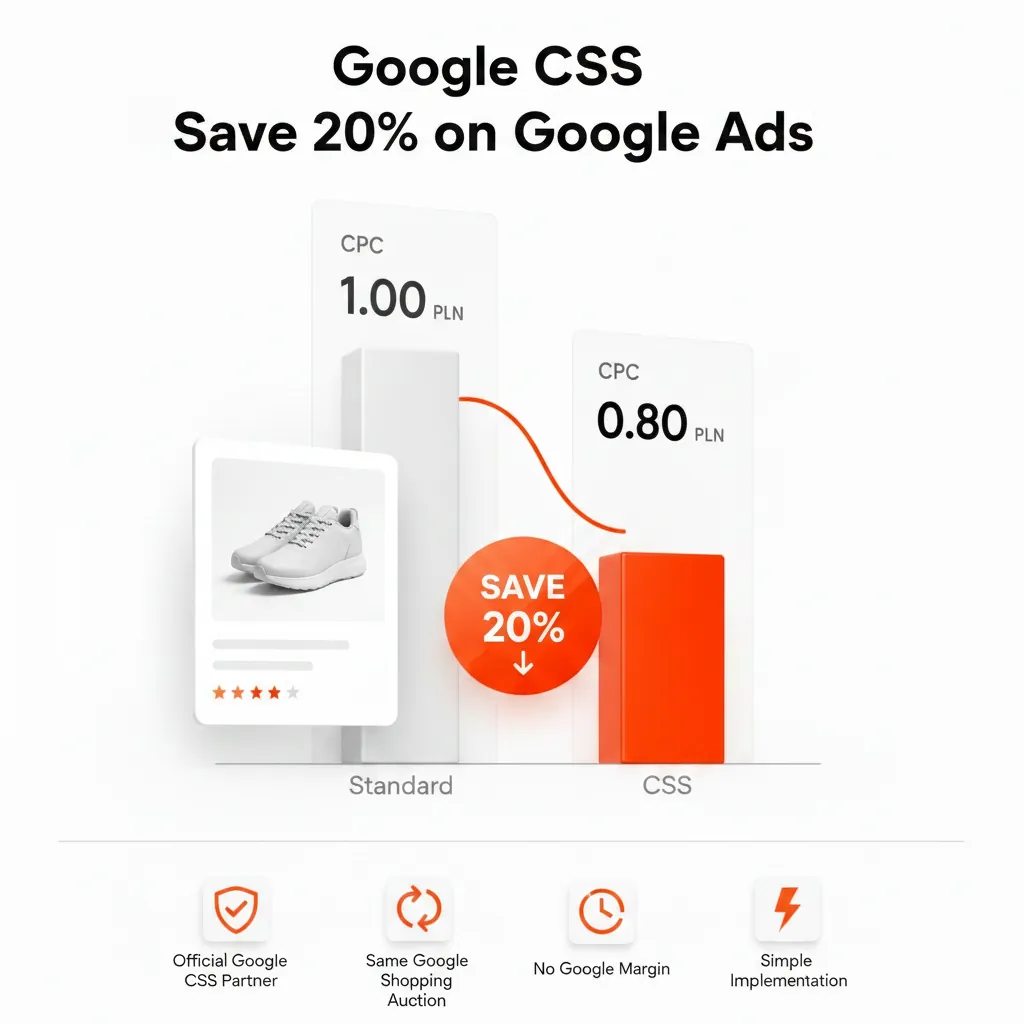
The saving you can expect from moving away from Google Shopping Europe comes from the program itself, not from the tier: Google Shopping Europe deducts a margin from each bid (widely estimated at around 20%), while an independent CSS doesn't. That is why switching to any independent CSS can lower Shopping CPCs by up to 20%, depending on your category and competition. The details are in Google CSS vs Google Shopping Europe.
You can use several CSSs at once
Google allows merchants to advertise with several CSSs at the same time to find the best combination. Each CSS uses a separate Merchant Center account, and a merchant is never second-priced against itself. So you don't have to pick a CSS for its badge alone – you can compare results.
How to check which CSS runs your ads
If you are not sure which CSS you use today, look in Merchant Center. Google says you will find there a list of all CSSs that have uploaded products from your website. Your Shopping ads also show the name of the CSS in a small link at the bottom of the ad. If you have never chosen a CSS, you are most likely using Google Shopping.
Checklist: questions to ask any CSS, Premium or not
- Pricing model. Flat monthly fee, CPC markup or commission? Work out the total cost at your real budget.
- Countries. Does it cover every program country you sell in?
- Surfaces. By default a CSS places products only in the Shopping unit on Google Search. Ask whether it also covers other surfaces you rely on.
- Account control. Do you keep your own Google Ads and Merchant Center accounts?
- Contract. Minimum term and notice period.
- Status claims. If a CSS says it is a Premium Partner or has the Google Retail Expert badge, ask which one it means and for which region.
A longer list of questions is in how to choose a Google CSS partner. When you have decided, the move itself is described in how to switch CSS partner. Agencies that want to offer CSS under their own brand can read about white label CSS.
Where Feedve stands
Feedve is an independent CSS partner in all 21 program countries. It is not a Premium Partner. Merchants keep their own Google Ads and Merchant Center accounts and pay a flat monthly fee with no commission on ad spend – see pricing.
Frequently asked questions
What is a CSS Premium Partner?
The highest tier of Google's CSS Partners Program. It is meant for CSSs in the top 10% by Shopping ad impressions in their region that also commit to an annual Joint Partnership Plan and four Quarterly Business Reviews with Google.
Do Premium Partners get better positions or lower CPCs?
Google's program pages describe Premium status as specialist support for the CSS. According to Google, all CSSs compete in the same auction, no CSS has reserved ad space, and all CSSs have access to the same features. Nothing in the tier criteria guarantees a merchant better positions or lower CPCs.
What is the Google CSS partner program?
Google's program for comparison shopping services, with three tiers – Participant, Partner and Premium Partner – that give a CSS access to training, strategic insight and technical support. What it takes to become a CSS in the first place is covered in Google CSS partner requirements.
How often does Google review the tiers?
Once a year, in a formal review. Tier changes happen only after that review, and most metrics are measured over a rolling 30-day window.
Is Premium status a rating of service quality?
No. Every CSS in the program, of any tier, places ads under the same Google rules. Premium is a tier within Google's CSS Partners Program, based on impression volume and partnership commitments – not a rating of the service a merchant receives.